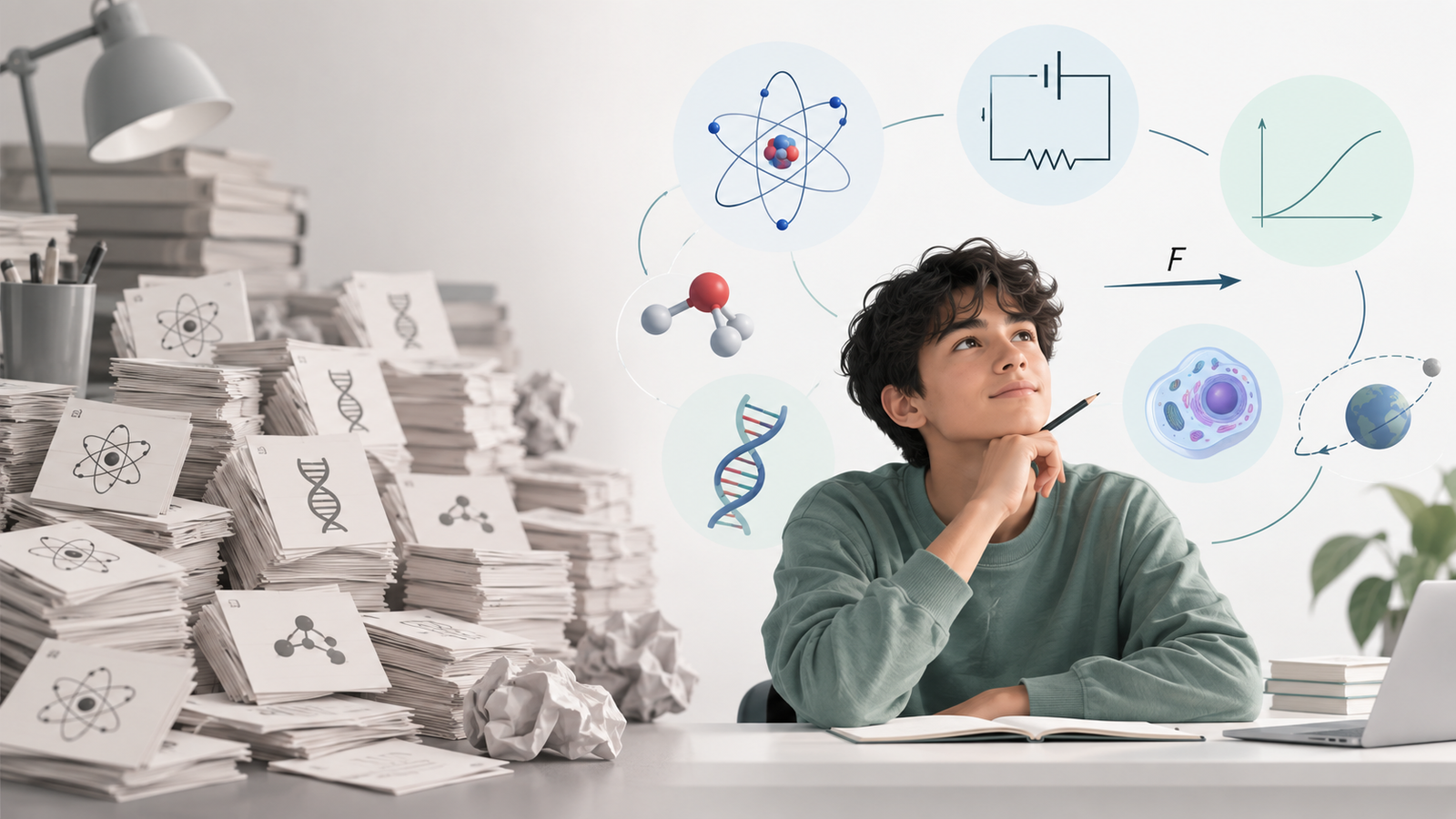
Science contains plenty of facts. But learning Science is not simply about remembering more facts.
A student may memorise that increasing temperature can increase the rate of a chemical reaction. But what happens when the examination presents a situation the student has never seen before?
That is where understanding matters.
If the student understands that particles move faster at a higher temperature, resulting in more frequent effective collisions, the student can apply the same idea to many different questions.
The same principle applies across Science.
In Physics, understanding forces is more useful than memorising answers to individual force questions.
In Chemistry, understanding particles makes topics such as bonding, reactions and changes of state easier to connect.
In Biology, understanding relationships between structures and functions makes it easier to explain unfamiliar situations.
Learn the idea, not just the sentence
Memorisation still has a place in Science. Definitions, equations, terminology and certain facts need to be remembered.
But memory should sit on top of understanding.
A useful question to ask yourself while revising is:
“Can I explain why this happens?”
If you cannot, you may know the fact without truly understanding the Science.
Another useful test is to change the question slightly.
Can you still solve it?
If changing the context causes everything you have memorised to fall apart, the concept probably needs more work.
Understanding makes Science transferable
Good Science teaching therefore goes beyond telling students what to remember.
Students should learn to:
- recognise the scientific principle involved;
- explain what is happening;
- connect different concepts;
- interpret information they have not seen before; and
- communicate their reasoning accurately.
That is the difference between remembering Science and being able to use Science.
Understanding Science. Answer like an examiner.